
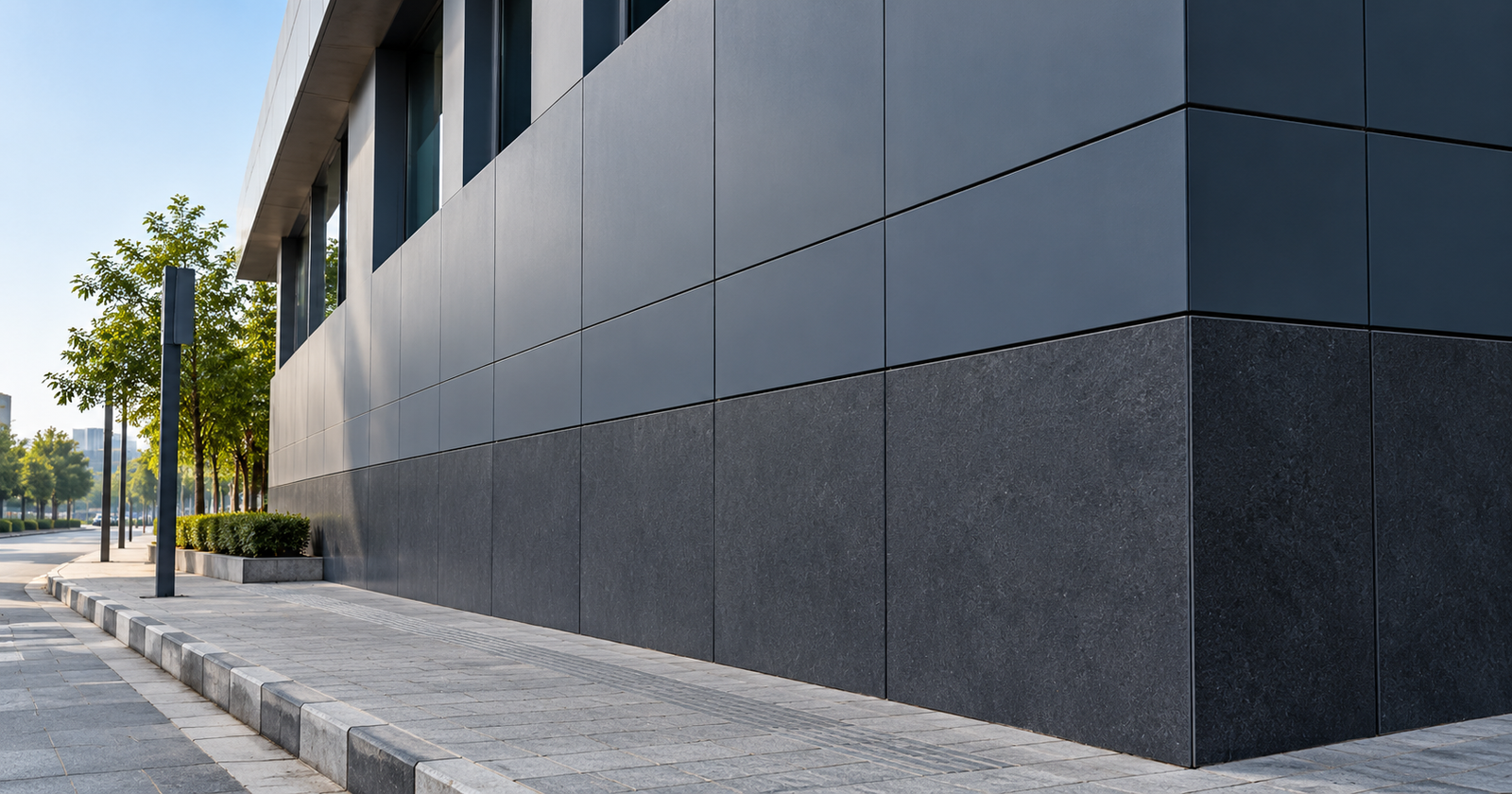
Anti-graffiti HPL uses a surface film with very low surface tension, so paint, marker and adhesive sit on top of the panel rather than keying into it and can be removed with a solvent wipe without damaging the finish. On street-level public facades it is the difference between a cleanable surface and a permanent problem.
The Problem It Solves
Any facade at street level in an Indian city deals with the same set of insults: spray paint, permanent marker, poster paste and the torn paper left behind, handbills, chewing residue, and general soiling from traffic and dust.
On an ordinary painted or coated surface, removal attempts damage the finish. Solvent lifts the paint. Scrubbing dulls it. The result is a patchwork of cleaned areas that look worse than the graffiti did, which is why most building managers eventually stop trying and repaint instead.
How the Technology Works
Anti-graffiti grades carry a specialised surface film — typically incorporating a fluoropolymer layer such as PVDF — with very low surface energy. Several properties follow from that:
- Graffiti resistance — paint and marker cannot key into the surface, so they can be wiped off with an appropriate solvent
- Chemical resistance — the panel tolerates the cleaning solvents required, which is the part that matters; a graffiti-resistant surface that solvent destroys is not useful
- Anti-soiling — dust and pollution adhere less readily, so the facade stays cleaner between washes
- Anti-fouling — reduced biological growth in damp, shaded conditions
- Extended UV protection — these films typically also improve colour stability
Where to Specify It
Anti-graffiti grade costs more than standard exterior HPL, so it is specified selectively rather than across a whole building.
Strong candidates:
- Metro and railway station facades and concourses
- Bus terminals and transport interchanges
- Public toilets and civic amenity buildings
- School and college boundary-facing elevations
- Underpasses, subways and pedestrian tunnels
- Retail and commercial frontages on busy streets
- Hospital external walls at ground level
- Any facade within reach from a public footpath
Usually unnecessary: upper floors, facades behind secure boundaries, rear and service elevations, and private residential projects with gated access.
The Sensible Specification Approach
The practical pattern on most public buildings is a vertical split: anti-graffiti grade from ground level to roughly three metres — the reachable zone — and standard exterior grade above it.
This is the approach HPL Maker recommends on most civic and transport work. It captures almost all of the benefit at a fraction of the cost. Where the design allows, a deliberate horizontal band or change of shade at that transition makes it read as intentional rather than as a budget decision.
Practical Notes
- Confirm which solvents are approved. The grade is only useful if the facilities team knows what to use. Get the cleaning procedure from the manufacturer and hand it over at handover.
- Act promptly. Anti-graffiti grades are far easier to clean when the mark is fresh. Weeks of sun baking on spray paint makes any surface harder.
- Brief the maintenance team. Specifying the product and then letting someone attack it with an abrasive pad defeats the point entirely.
- Anti-graffiti is not anti-scratch. It resists marking, not physical gouging. Deliberate scoring will still damage the surface.
- Check it is combined with the fire grade you need. Public buildings usually require FR classification as well; confirm the specific product carries both.
Lifecycle Argument
On a civic or transport building, the comparison is not against standard HPL board cost. It is against the recurring cost of repainting or replacing a street-level facade that cannot be cleaned, plus the period during which the building looks neglected.
For public assets held for decades by the same owner, that argument is usually straightforward to make to the facilities and estates side, even where the design budget resists it.
Frequently Asked Questions
What is anti-graffiti HPL?
Exterior HPL with a low-surface-energy protective film, usually fluoropolymer-based, that prevents paint and marker from keying into the surface so they can be wiped off with solvent.
Does graffiti come off completely?
Generally yes with prompt treatment and the approved solvent. Long-weathered marks are harder on any surface.
Is anti-graffiti grade worth the extra cost?
On street-level public and transport buildings, usually yes. On upper floors and secured sites, usually not. A ground-to-three-metre band is the efficient compromise.
Can anti-graffiti HPL also be fire-rated?
Products combining both exist. Confirm that the specific variant you are specifying carries both classifications, since certificates cover tested variants rather than whole ranges.
Specifying a public or transport facade? Contact HPL Maker for anti-graffiti grade availability and cleaning documentation.